5. Parallel Axis Theorem
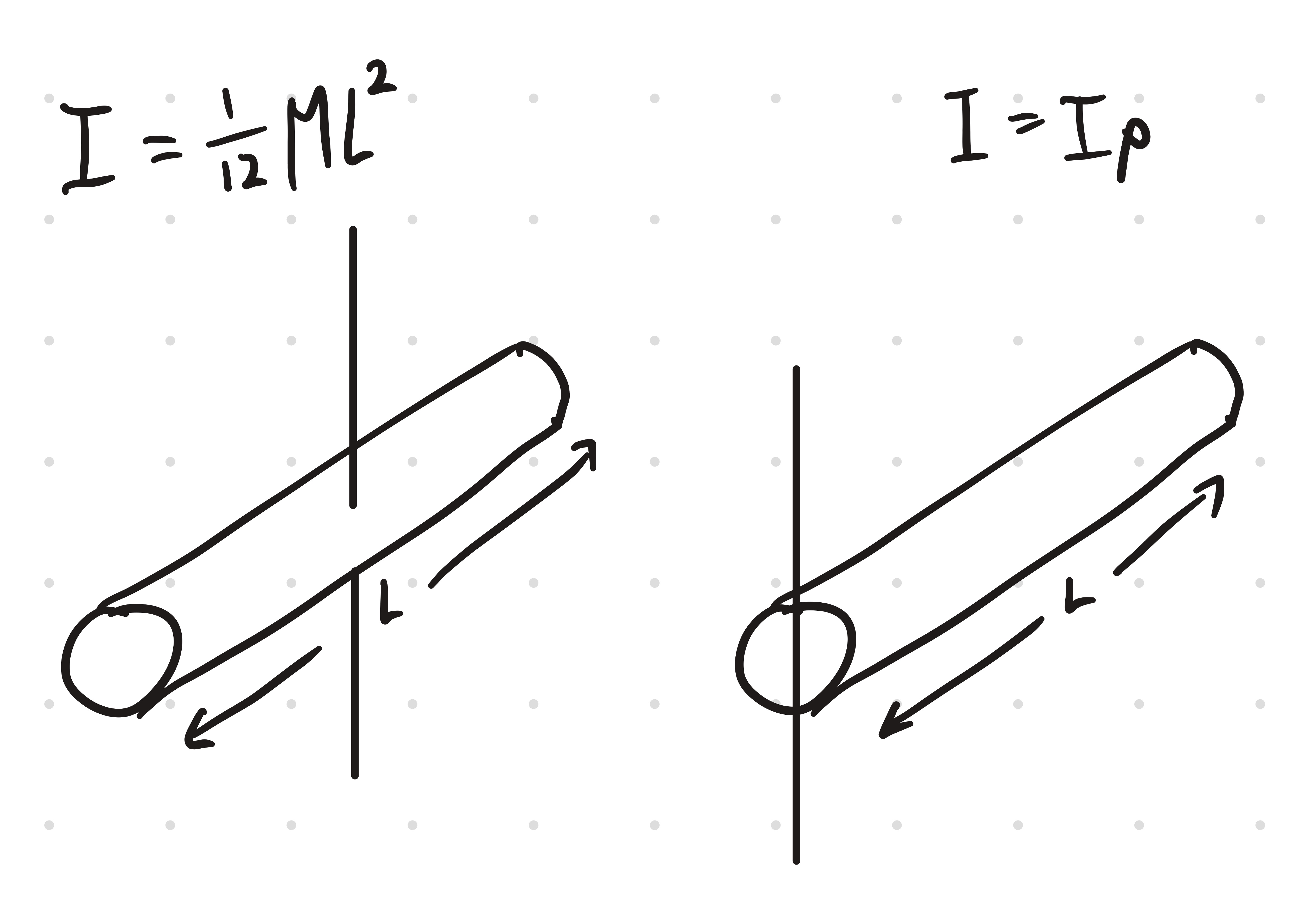
Relating moments of inertia about parallel axes
Definitions
Parallel Axis Theorem
- A theorem that relates the moment of inertia about any axis to the moment of inertia about a parallel axis through the center of mass
where is the moment of inertia around the rotation axis, is the moment of inertia around the centre of mass, is the total mass, and is the distance between the two parallel axes
Derivations
objects don't always rotate around the most convenient axis
the parallel axis theorem states that
where is the moment of inertia about a parallel axis at distance from the center of mass
this allows us to calculate the moment of inertia about any parallel axis if we know the moment of inertia about the center of mass
Useful Equations
Example 1
A slender rod of mass and length rotates about an axis through one end. Given that , what is the moment of inertia about the end?
Answer
Using the parallel axis theorem with
Example 2
A disc of mass 5 kg has a moment of inertia about its center of 0.5 kg⋅m². What is its moment of inertia about an axis parallel to the center axis but 0.2 m away?
Answer
Using