Physics

3. Angular Acceleration

Rate of change of angular velocity and its components
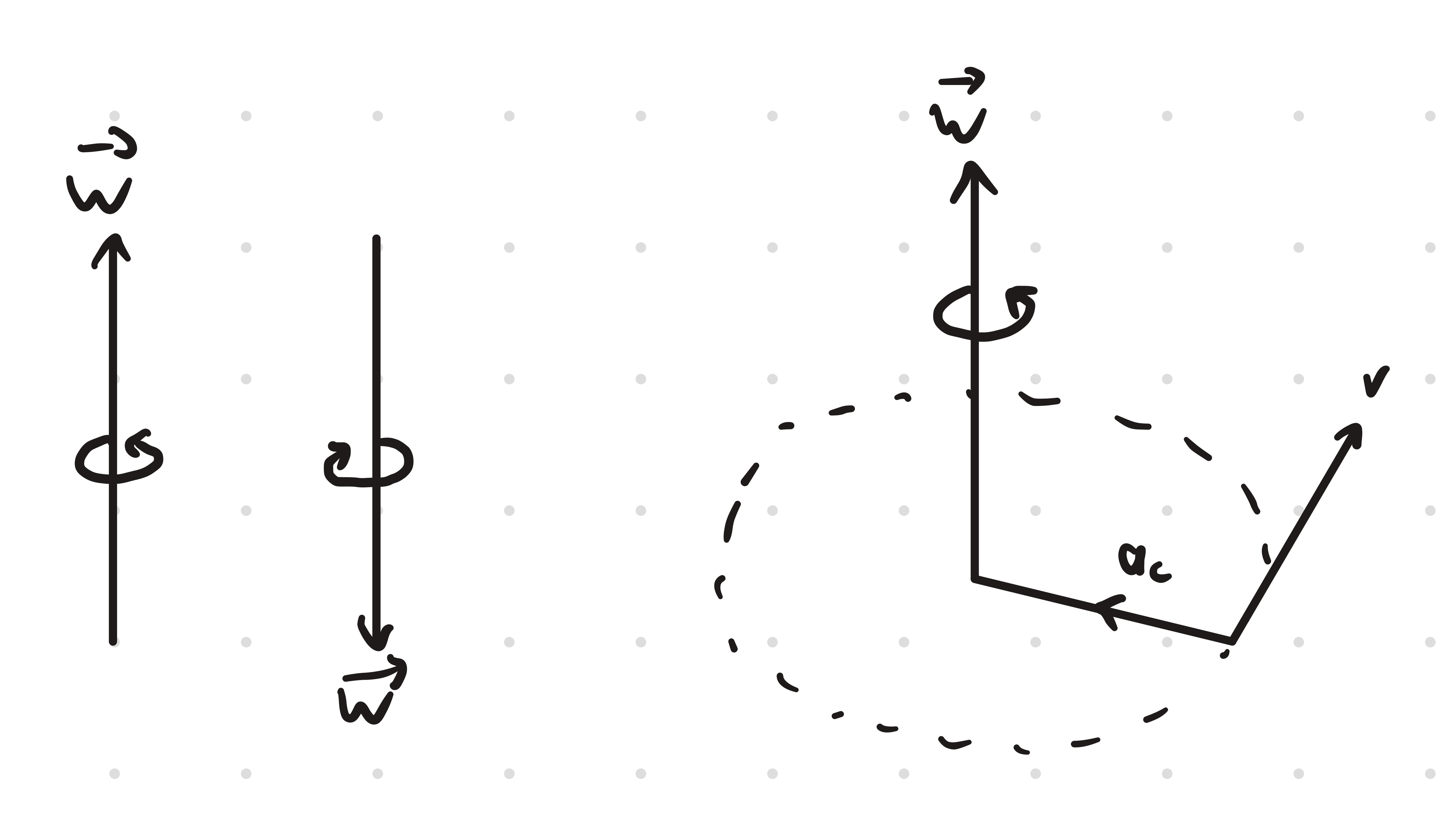
Angular Acceleration

Definitions

Angular Acceleration (α)

  • Rate of change of angular velocity, measured in rad/s²
α=ΔωΔt\alpha = \dfrac{\Delta \omega}{\Delta t}

Tangential Acceleration

  • Changes the magnitude of the angular velocity

Radial (Centripetal) Acceleration

  • Points toward the centre of the circular path and changes the direction of the velocity


Derivations

by definition, angular acceleration is

α=ΔωΔt\alpha = \dfrac{\Delta \omega}{\Delta t}

taking the limit as Δt0\Delta t \to 0

α=limΔt0ΔωΔt=dωdt\alpha = \lim_{\Delta t \to 0} \dfrac{\Delta \omega}{\Delta t} = \dfrac{d\omega}{dt}

for an object moving in a circle, acceleration can be decomposed into two components

a=(atac)\vec{a} = \begin{pmatrix} a_t \\ a_c \end{pmatrix}

deriving ata_t and aca_c, starting with

v=ωrv = \omega r

take the derivative with respect to time

dvdt=dωdtr+ωdrdt\dfrac{dv}{dt} = \dfrac{d\omega}{dt}r + \omega\dfrac{dr}{dt}

this can be rewritten as

a=αr+ωdrdta = \alpha r + \omega\dfrac{dr}{dt}

therefore, the radial (centripetal) acceleration is

ac=αra_c = \alpha r

and the tangential acceleration is

at=ωdrdta_t = \omega\dfrac{dr}{dt}


Constant Angular Acceleration

assuming constant angular acceleration

α=constant\alpha = \text{constant} dω=αdtd\omega = \alpha dt

integrate both sides

ω0ωdω=0tαdt\int_{\omega_0}^{\omega} d\omega = \int_{0}^{t} \alpha \, dt ωω0=αt\omega - \omega_0 = \alpha t ω=ω0+αt\boxed{\omega = \omega_0 + \alpha t}

if we solve for θ\theta

dθdt=ω0+αt\dfrac{d\theta}{dt} = \omega_0 + \alpha t θ0θdθ=0t(ω0+αt)dt\int_{\theta_0}^{\theta} d\theta = \int_{0}^{t} (\omega_0 + \alpha t)\, dt θθ0=ω0t+12αt2\theta - \theta_0 = \omega_0 t + \frac{1}{2}\alpha t^2 θ=θ0+ω0t+12αt2\boxed{\theta = \theta_0 + \omega_0 t + \frac{1}{2}\alpha t^2}


Useful Equations

α=dωdt,ac=αr,at=ωdrdt\alpha = \dfrac{d\omega}{dt}, \quad a_c = \alpha r, \quad a_t = \omega\dfrac{dr}{dt} ω=ω0+αt\omega = \omega_0 + \alpha t θ=θ0+ω0t+12αt2\theta = \theta_0 + \omega_0 t + \frac{1}{2}\alpha t^2


Example 1

A wheel starts from rest and accelerates with a constant angular acceleration of 2 rad/s². What is its angular velocity after 5 seconds?

Answer

Using ω=ω0+αt\omega = \omega_0 + \alpha t with ω0=0\omega_0 = 0

ω=0+2×5=10 rad/s\omega = 0 + 2 \times 5 = 10 \text{ rad/s}


Example 2

A disc rotates with an initial angular velocity of 4 rad/s and angular acceleration of 3 rad/s². How many radians does it rotate through in 2 seconds?

Answer

Using θ=θ0+ω0t+12αt2\theta = \theta_0 + \omega_0 t + \frac{1}{2}\alpha t^2 with θ0=0\theta_0 = 0

θ=0+4(2)+12(3)(2)2\theta = 0 + 4(2) + \frac{1}{2}(3)(2)^2 θ=8+6=14 rad\theta = 8 + 6 = 14 \text{ rad}