5. Distributed Mass Pendulum
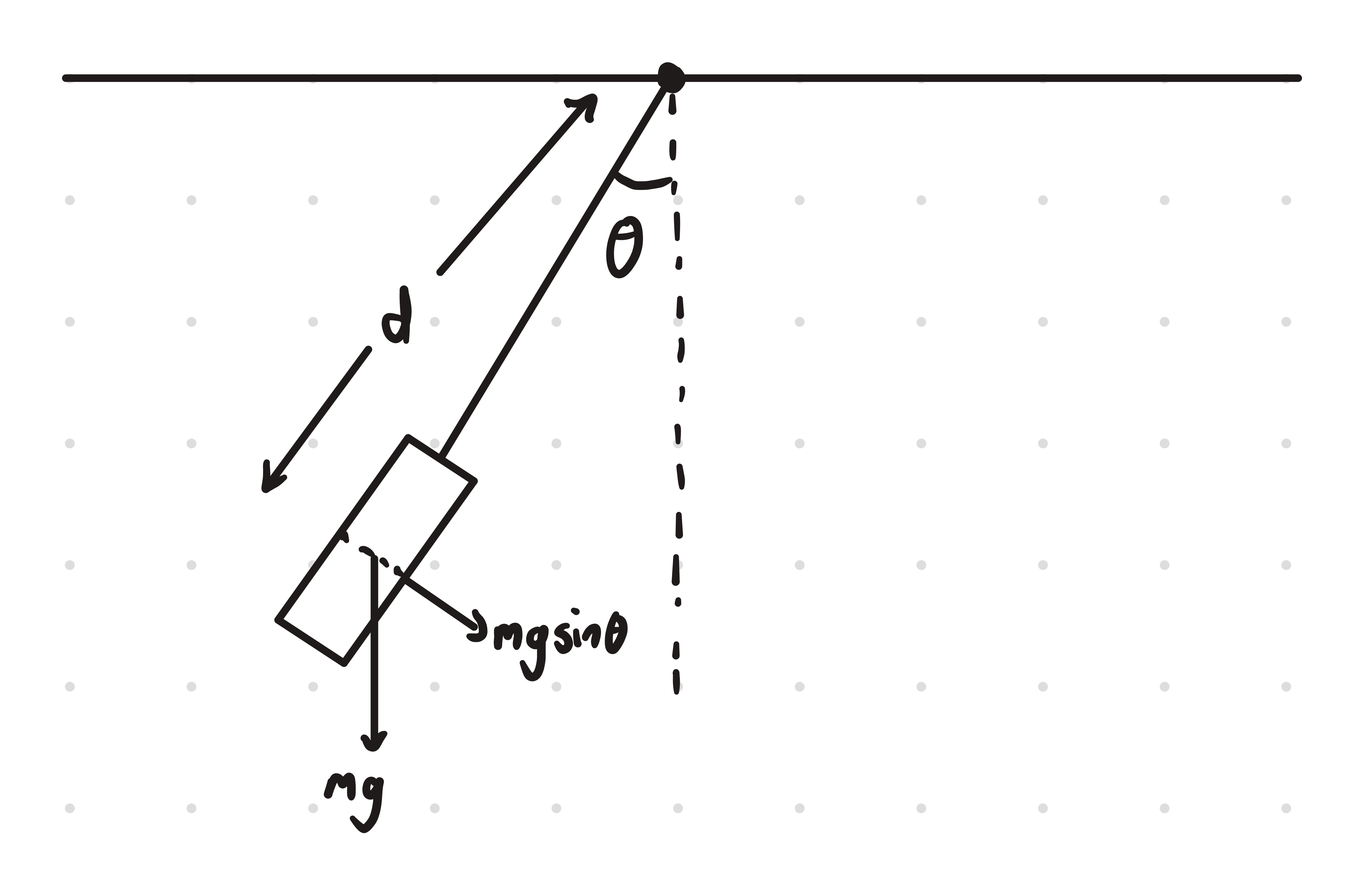
A pendulum whose mass is spread along its length rather than concentrated at a point.
Definitions
Distributed Mass Pendulum
- A pendulum whose mass is spread along its length rather than concentrated at a point.
Derivations
Angular Velocity
Restoring force
for small angles
therefore
so
rewritten we get
this is in the form of a SHM therefore
Kinetic Energy
Since
we can write the kinetic energy as
integrate both sides
Useful Equations
Example 1
A physical pendulum consists of a thin, uniform rod of length . The rod is pivoted at one end and undergoes small oscillations.
Calculate the period of oscillation.
Answer
Moment of inertia of a rod
equation for period
is the distance to the centre of mass so
subbing and into the equation for the period
simplify
Example 2
A physical pendulum consists of a thin, uniform rod of length and mass , pivoted at one end. At a given instant, the rod has angular speed ()
Calculate the kinetic energy of the rod.
Answer
Moment of inertia for a uniform rod
sub into kinetic energy equation
therefore