2. Time Dialation
-----
Definitions
Inertial Frame
-
An inertial frame of reference is one which bodies move in a straight line at constant speeds
-
Different frames of reference move relative to one another
Einstein's Postulates
-
Physics laws have the same form in all inertial frames
-
The speed of light in free space is invariant
Proper Time
- time for stationary observer
Observer at constant ()
- time measured in frame of observer
Lorentz Factor
-
where is relative velocity and is the speed of light
-
Relates measurements between different inertial reference frames
-
Appears in time dilation equation:
-
Derivations
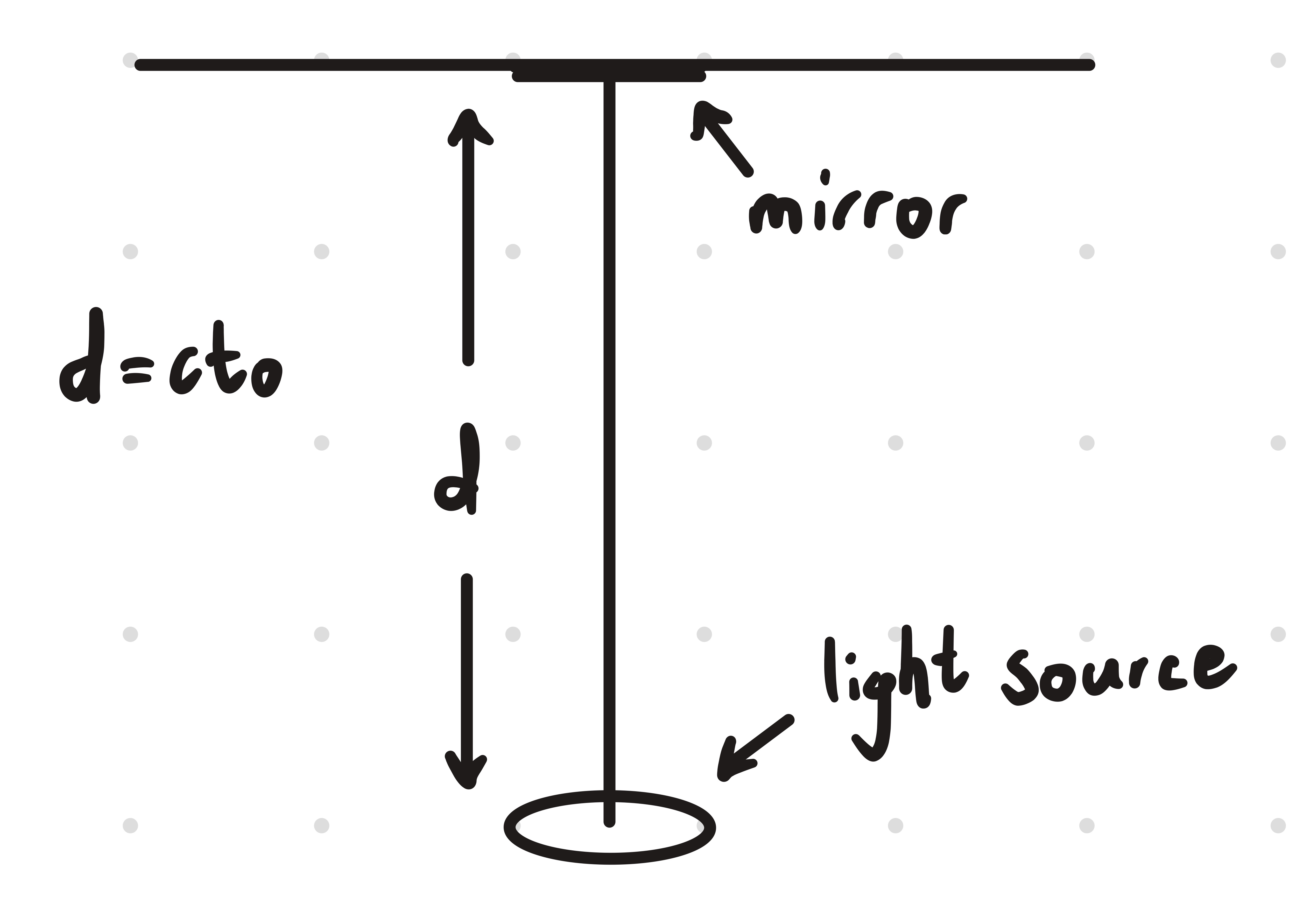
Imagine if someone on a train shone a light on a mirror such that the light travelled in a straight line
Frame 1: Proper Time
If someone outside the train where to view the path of light, it would travel at an angle.
This means the light would travel further
However since the speed of light is constant, the time taken for the light to travel its respective distance, must be longer
Frame 2: Observer Time
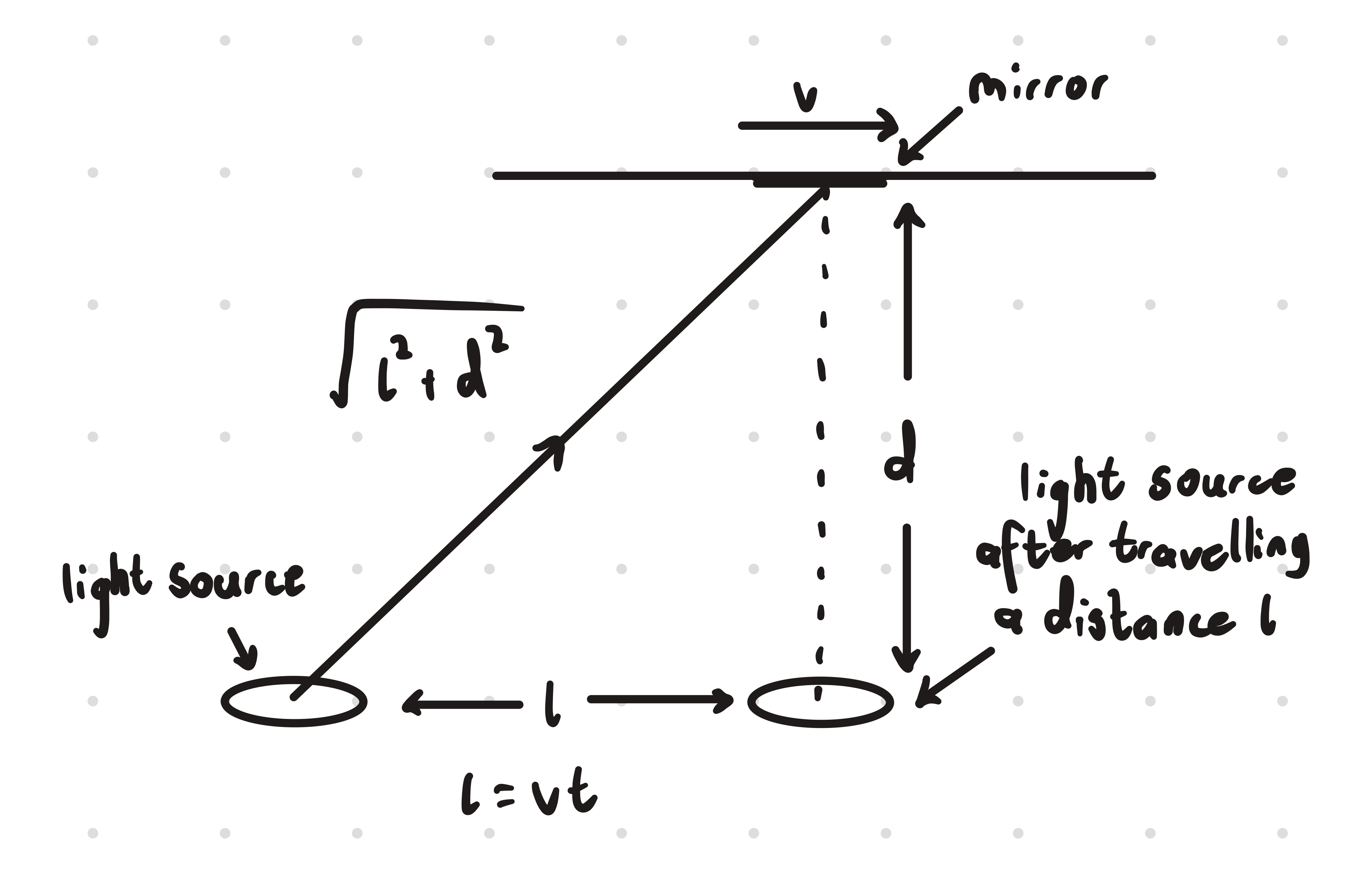
we can calculate
subbing in and
solving for we get
or rewritten as
since
then
therefore more time has passed for the observer
Useful Equations
Example 1
A spacecraft travels at relative to Earth. If seconds pass on a clock aboard the spacecraft, how much time passes on Earth?
Answer
calculate the Lorentz factor
apply the time dilation formula
therefore seconds pass on Earth while seconds pass on the spacecraft
Example 2
A particle is accelerated to in a laboratory. If the particle's internal clock measures s before it decays, how long does it appear to exist in the laboratory frame?
Answer
calculate the Lorentz factor
apply the time dilation formula
the particle appears to exist for approximately s in the laboratory frame
Example 3
A GPS satellite orbits at a speed where . If day passes on the satellite, how much more time passes on Earth?
Answer
using with day
the time difference is
converting to microseconds ( day s)
Earth clocks are ahead by approximately microseconds per day, which must be corrected for GPS accuracy